A Comparative Research of Ubisoft Reflections and Industrial Light & Magic: Career Report Vfx
Introduction
As a visual artist in the CG and interactive entertainment industry, I have always been passionate about digital content production for games and films. Through an in-depth study of Ubisoft Reflections and Industrial Light & Magic (ILM), I have refined my career goals and identified the skills and pathways necessary to succeed. This report investigates both companies’ history, core projects, culture, job expectations, and how I align with them.
Company Overview & History
Based in Newcastle, UK, Ubisoft Reflections is a subsidiary of Ubisoft, specialising in the development of AAA titles such as Assassin’s Creed, Watch Dogs and Rainbow Six. The main style is realistic/semi-realistic, with a tone that favours realistic storytelling and immersion. The company’s culture is Collaborative, emphasising imagination and innovation.
Founded in 1975 by George Lucas, Industrial Light & Magic is headquartered in San Francisco with offices in London and Singapore. Its works include Star Wars, The Avengers and Avatar. Production styles are realistic to surreal. ILM is a technology-driven company that promotes interdisciplinarity through its Jedi Academy, which provides entry points for junior artists into cinematic CG.
Why I Aspire to Work There
As a lifelong fan of high-end CG productions, working at Ubisoft or ILM is my dream. Growing up in an artistic family and with years of exposure to stunning CG like Love, Death + Robots and World of Warcraft , I have developed a refined sense of visual quality. I’ve received seven years of academic training across fine arts and design, gaining strong skills in drawing, modeling, and rendering. However, I still need to broaden my stylistic flexibility and improve animation skills. Still, I am committed to contributing to these companies with my passion and discipline.
Desired Position
At Ubisoft Reflections, I aim to be a junior 3D environment modeller, character designer or prop artist, handling full pipeline production from modeling to texturing.
At ILM, I aim to contribute to sci-fi modelling with a focus on hard surface or creature designers. If employed, I would like to further expand skills such as Maya animation, UE ground editing, Python,ZB sculpting, SP, etc. in the animation and rendering department.
Skill Requirements and Career Match
Ubisoft Reflections focuses on modelling and UE use of fundamentals, building skills including Maya and SP. I have a complete workflow and a foundation in modelling, but need to learn additional software.
ILM on the other hand focuses on hyper-realism with a more cinematic workflow such as Houdini, ZBrush, VRay and scripting. I need to apply to Jedi Academy but need to learn additional software and need to improve compositional understanding and animation fundamentals.
Short and long term goals
This year I made a realistic 3D wolf and completed a study of my architectural design. I also started Maya and UE.
Short-term goals: In the next year, I will refine my portfolio and learn ZB, Maya, UE, and Python for people and scenes. I intend to join these two or other related game companies after I graduate from MA. Also, I will set up my own Art Station and LinkedIn sites, participate in workshops and competitions.
Long term: aiming for an Art Director or CEO position at both companies to design and produce a film/game.
Industry Contact & Alternatives
Both companies recruit primarily via their websites and LinkedIn. Applications go through online forms; there is no known agency collaboration. Other similar companies include Framestore, INK, DNEG, Naughty Dog, and Playground Games, which are also worth following.
Conclusion
As a newbie in CG, I know that the industry has a high threshold and is highly competitive, but I always keep my passion for learning and motivation for creation. In the future, no matter whether I can get into my ideal company immediately or not, I will continue to accumulate experience, and one day I will be the best in this field.
Unit Blog
Game or Film?
As the final unit of our second year, we began to have to choose between career directions. Game or film? At first I was idealistic, I always thought I could work for ILM later on or even make a film myself, but this was undoubtedly delusional. As a newbie, I needed generalist industry skills to enter the company, and in this regard, gaming required more knowledge in this area compared to film, because in addition to needing deep insights in art I also had to be familiar with programming, game level understanding, etc., so I chose game.
About the game, we are focusing on creating movements for the characters and importing them into UE to get them up and running via the keyboard. So I’ve been introduced to new 3D software (Maya, Unreal Engine) and to be honest I’m very excited about it but I’ve never been very good at this part of animation, but this time with Paul directing Maya and Molly directing UE it’s become a lot more practical.
Maya basic operation
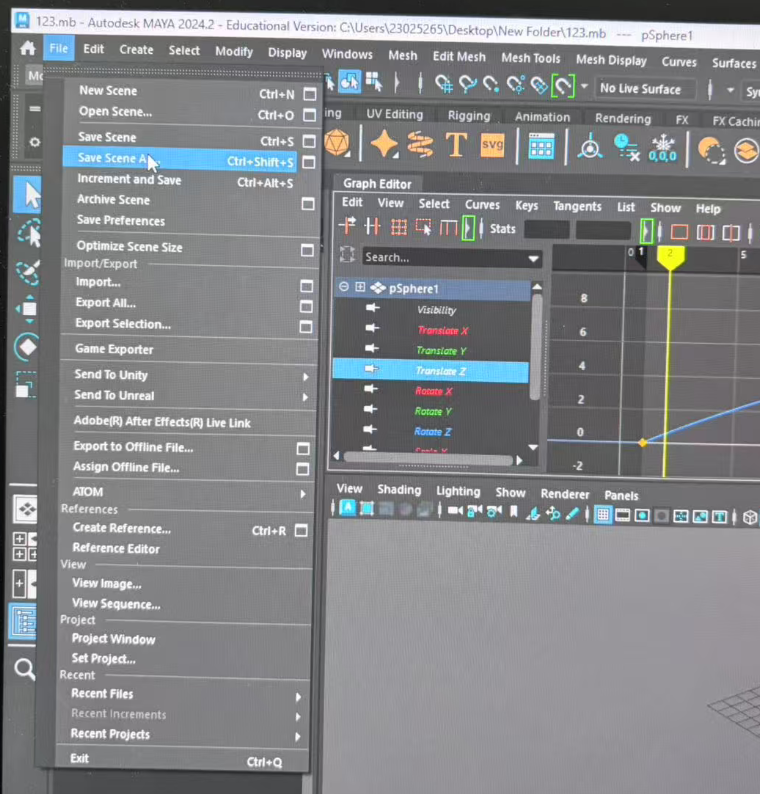
Save——Set Project-Project Window-Save Scene As
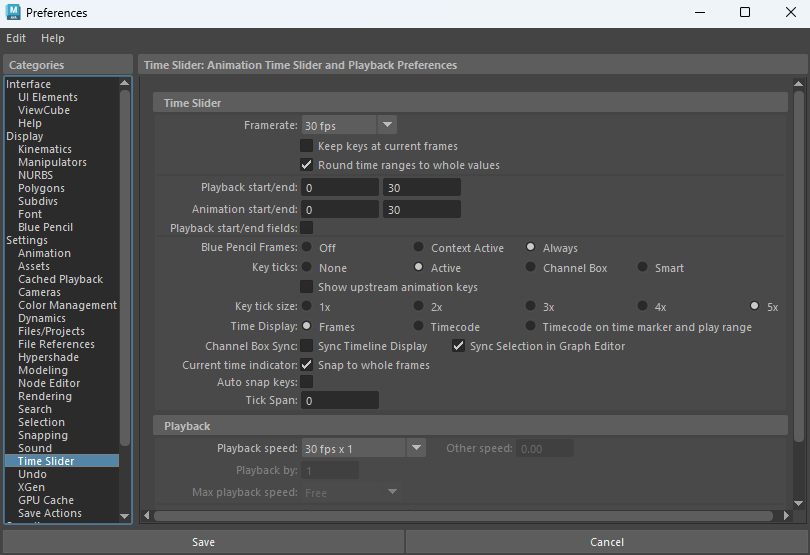
Animation Settings——5x-30 fpsx1
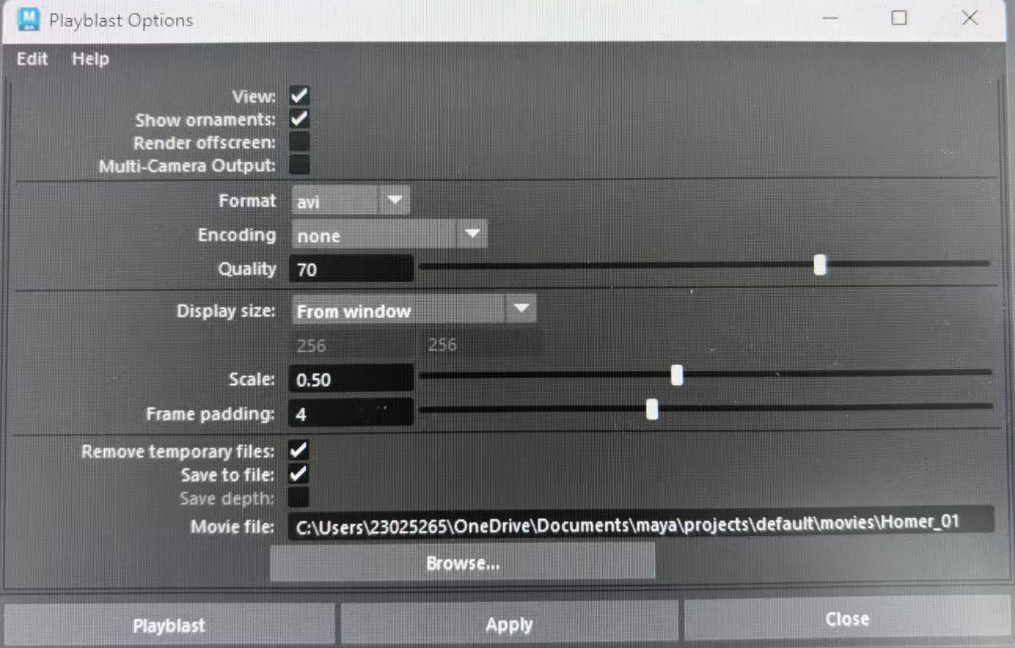
Preview——Playblast
Since my PDF has already stated and shown the corresponding frame rates and ideas for each action, I will only explain the important parts below.
Maya(idle, walk, run, single attack, double attack, blocking, take damage, dead)
Idle-(0-12-30)Except for the hands and head, the rest of the body will be relatively shorter when storing the force compared to releasing it, as these two parts belong to the end and are most affected during the conduction of force. The torso moves up and down and the arms swing back and forth.
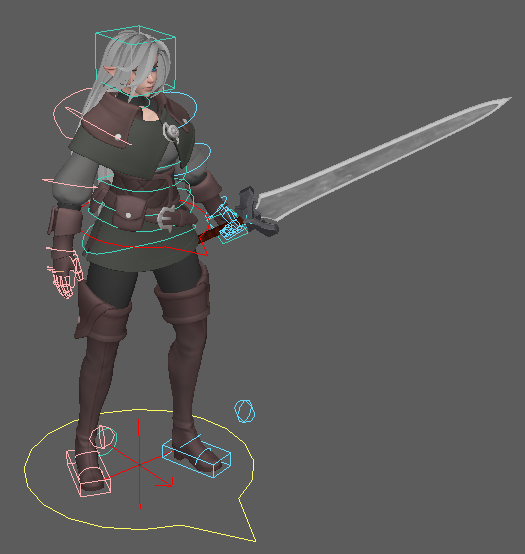
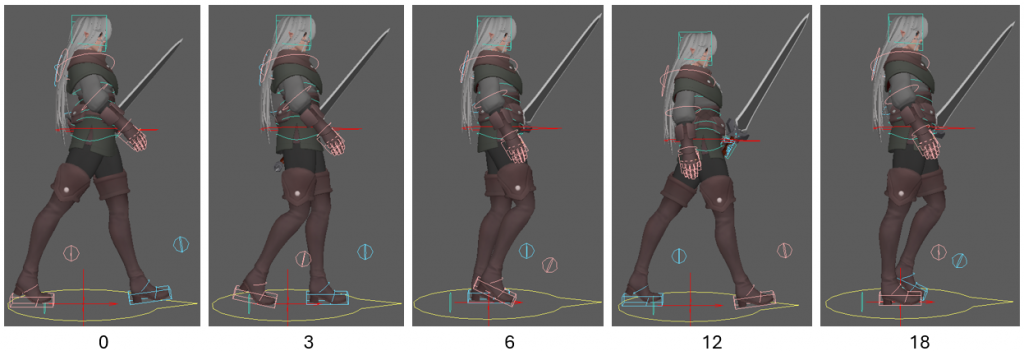
Walk-(0-3-6-12-18-24)
P1 This is an alternating cycle where the leg is fixed back (0-12) and stepped forward (12-24)
P2 During this time to show the weight of the stepping character the foot needs to be rotated at the ankle after the foot is lifted and before it lands in an alternating cycle


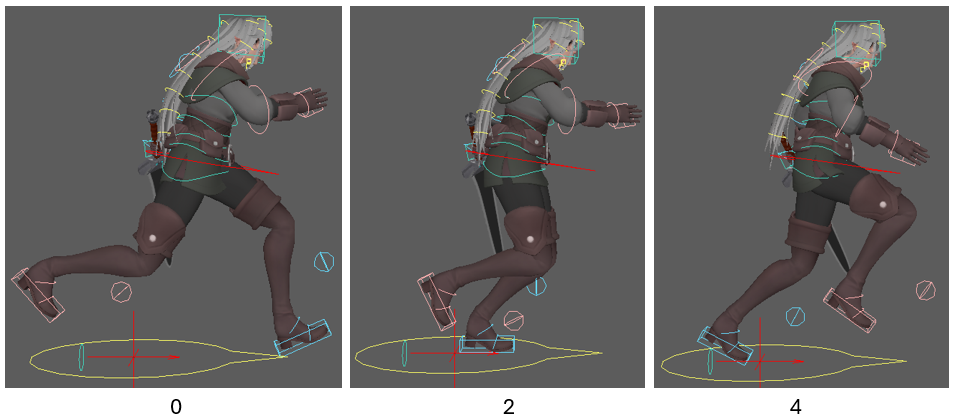
Run-(0-2-4-10-12-14-20)It’s the same as walking, except that during running the position of one foot on the ground is shorter so actually 0-10 and 10-20 are the same position just alternating between left and right foot, 0-2-4 (forward stride) 10-12-14 (stomping on the ground)

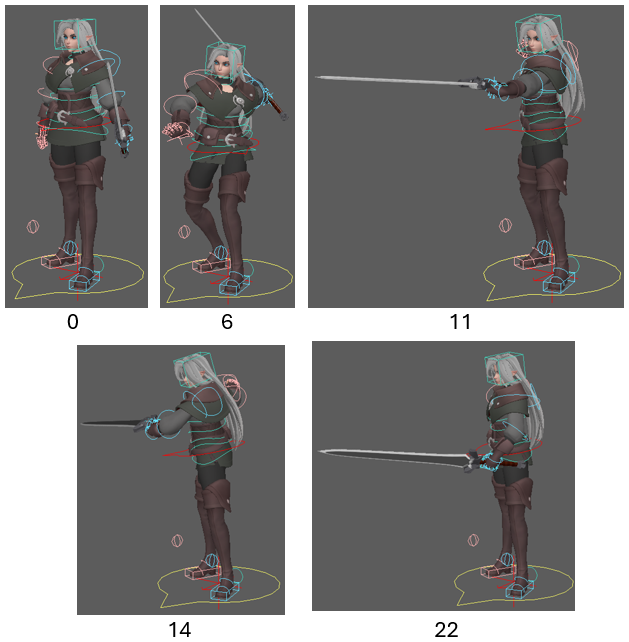
Attack-(0-6-11-14-22-30)(6) Crouch to build up strength – (11) Stand straight and lean forward to attack – (14) Inertia – (22) Retract sword
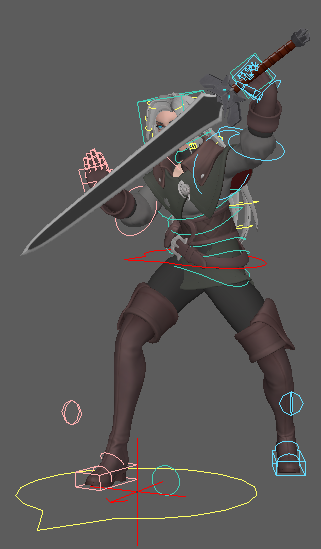
Blocking-(0-10-20)(10) Wrist and arm rotation/body push forward
Take damage-(0-7-14-21-28)(7) Body and left foot back and lean back after being struck – (14) Body and right foot stagger back and lean back – (21) Return to position
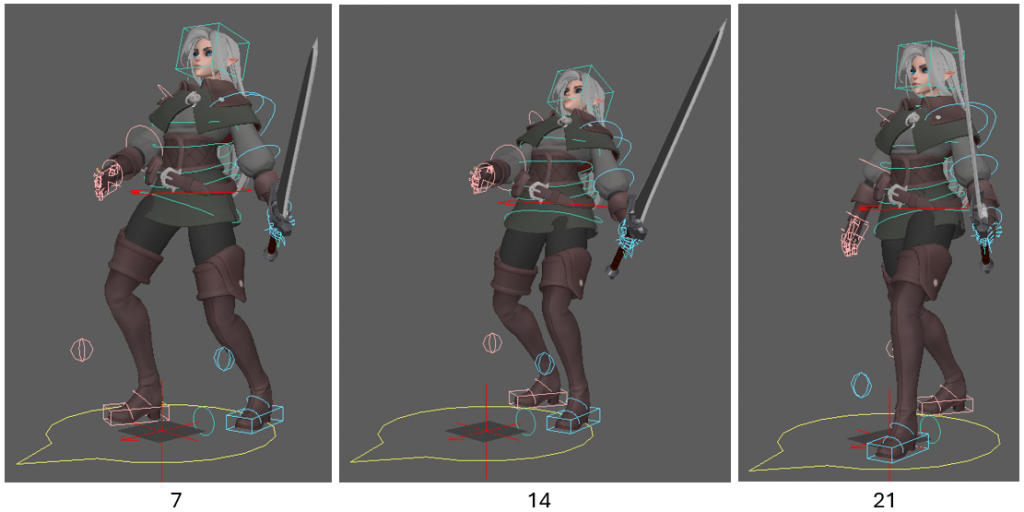
Dead-(0-10-20-28-30)(10) Loss of strength in the whole body, head down and knees – (20) Complete slumping – (22) Slight rebound- (28) Stationary
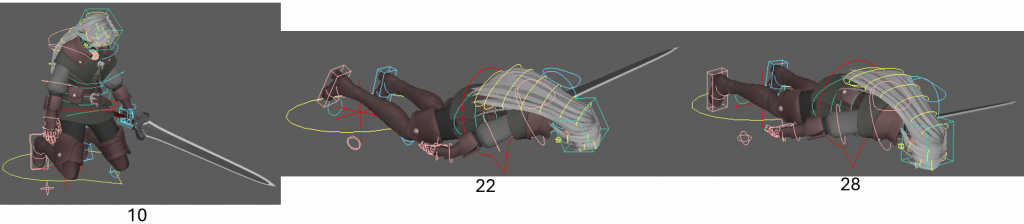
Unreal Engine
As I have shown all the relevant operational details in the PDF, the following will directly express what I felt and learnt.
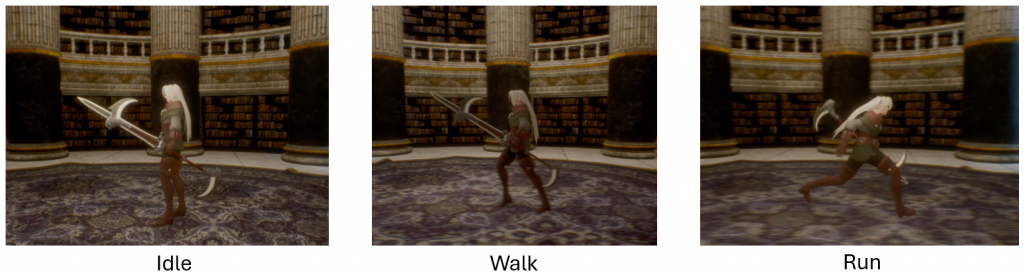
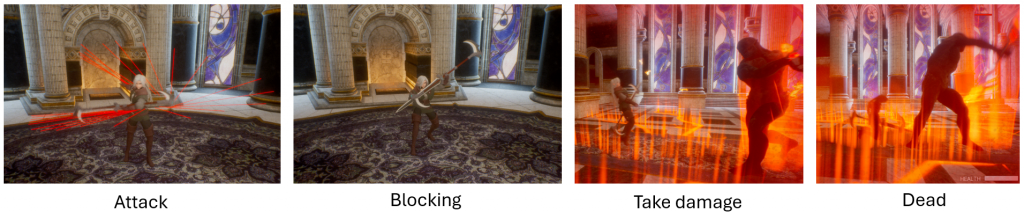
I must say that UE has dispelled the fear I’ve always had of making games, it requires no programming, just node connections, and the use of Blend Space and Blue Print to work Maya’s well-done character movements in a game scene.
Overall, this unit has made me less afraid of animating characters and using both 3D software, however, I still need to improve my understanding of game movement. It was clear that I lacked imagination in character movement and was not technically proficient, so hopefully I can work on this in the future!